
BPC-157 (Body Protection Compound-157) is a synthetic 15-amino-acid peptide based on a protective sequence associated with gastric juice. In canine wellness education, it is most often discussed for connective-tissue recovery, joint mobility, wound support, and digestive balance.
Important: There is no established, standardized canine BPC-157 protocol. The numbers below summarize ranges published by pet-education resources so owners can understand the math and have a more specific conversation with their veterinarian.
What BPC-157 is thought to do
Animal and preclinical discussions focus on repair signaling rather than simply masking discomfort. Proposed areas include blood-vessel formation around injured tissue, collagen and connective-tissue support, inflammatory signaling, and protection of the gastrointestinal lining. Dog-specific clinical evidence remains limited.
Common situations owners ask about
- Partial ACL/CCL tears and post-surgical recovery
- Inflammatory bowel disease (IBD) and chronic loose stool
- Arthritis and joint discomfort in senior dogs
- Muscle strains in active or working dogs
- Slow-healing skin or soft-tissue injuries
Weight-based ranges published in education materials
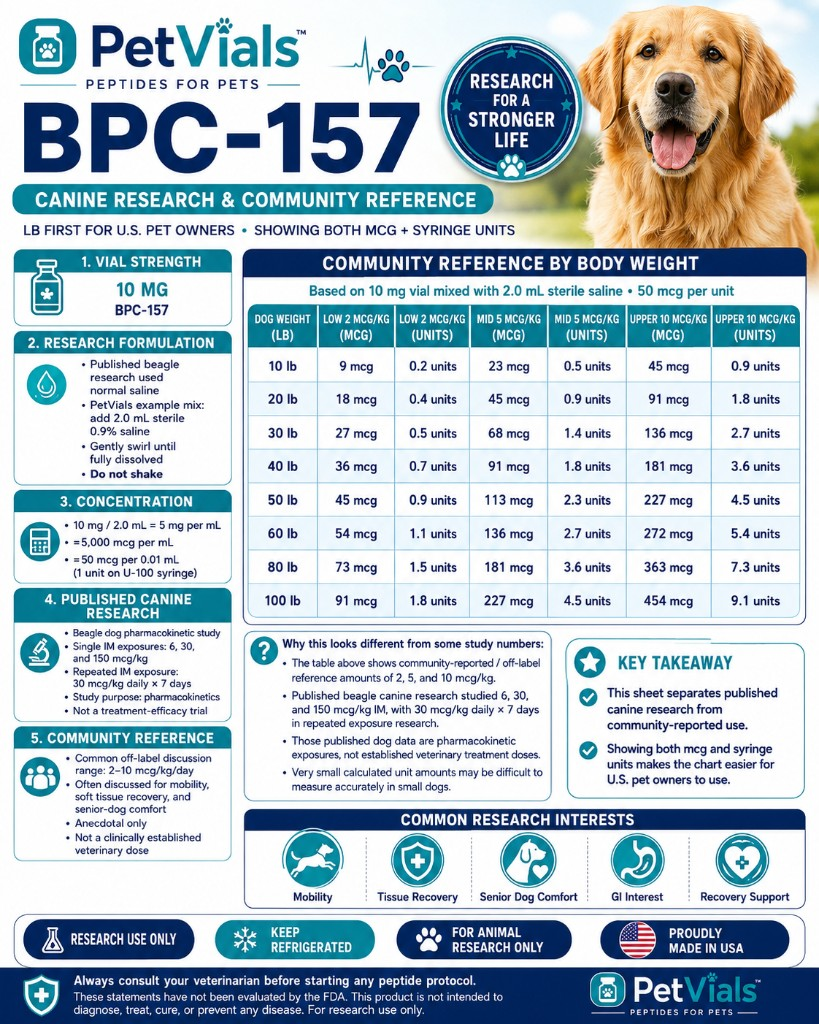
One commonly published framework uses 2 mcg/kg as a low reference, 5 mcg/kg as a middle reference, and 10 mcg/kg as a higher reference. These are educational calculations—not a prescription or a claim that a particular dog should receive one of these amounts.
| Dog weight | Weight | Low 2 mcg/kg | Middle 5 mcg/kg | Higher 10 mcg/kg | Middle range U-100 units* |
|---|---|---|---|---|---|
| 10 lb | 4.5 kg | 9 mcg | 23 mcg | 45 mcg | about 1 unit |
| 20 lb | 9.1 kg | 18 mcg | 45 mcg | 91 mcg | about 2 units |
| 30 lb | 13.6 kg | 27 mcg | 68 mcg | 136 mcg | about 3 units |
| 40 lb | 18.2 kg | 36 mcg | 91 mcg | 182 mcg | about 3.5 units |
| 50 lb | 22.7 kg | 45 mcg | 114 mcg | 227 mcg | about 4.5 units |
| 60 lb | 27.3 kg | 55 mcg | 136 mcg | 273 mcg | about 5.5 units |
| 70 lb | 31.8 kg | 64 mcg | 159 mcg | 318 mcg | about 6.5 units |
| 80 lb | 36.4 kg | 73 mcg | 182 mcg | 364 mcg | about 7 units |
| 90 lb | 40.9 kg | 82 mcg | 205 mcg | 409 mcg | about 8 units |
| 100 lb | 45.5 kg | 91 mcg | 227 mcg | 455 mcg | about 9 units |
*Unit estimates assume a 5 mg vial mixed with 2 mL, which equals 2,500 mcg/mL and 25 mcg per unit on a U-100 syringe. Values are rounded.
How to check the calculation
- Convert pounds to kilograms: pounds ÷ 2.205.
- Find the reference amount: kilograms × the selected mcg/kg range.
- Find concentration: vial amount in mcg ÷ water added in mL.
- Convert to volume: target mcg ÷ concentration in mcg/mL.
- Convert to U-100 units: volume in mL × 100.
Example: a 30 lb dog is about 13.6 kg. At the 5 mcg/kg educational reference, 13.6 × 5 = 68 mcg. With a 5 mg vial mixed with 2 mL, 68 mcg is about 0.027 mL, or roughly 2.7 U-100 units.
Why online charts do not always match
Some community charts use per-pound values such as 5, 7.5, or 10 mcg per 2 lb. Those convert to approximately 5.5, 8.3, and 11 mcg/kg, so they will produce higher numbers than a 2, 5, and 10 mcg/kg chart. Always check the stated unit, vial strength, water volume, and syringe concentration before comparing two charts.
Handling and administration concepts
- A U-100 syringe represents 100 units per mL, so one unit equals 0.01 mL.
- Reconstituted material is generally kept refrigerated; gently swirl rather than shake.
- Use clean handling practices and disinfect the vial stopper before each draw.
- Route, frequency, duration, and monitoring should be decided with a veterinarian.
Safety and monitoring questions
Published pet-education resources mention temporary lethargy, digestive upset, appetite changes, and injection-site irritation as possible observations. Long-term canine safety data are limited. Because angiogenesis is one proposed mechanism, active cancer or elevated tumor risk is an especially important veterinarian discussion. Pregnancy, nursing, major organ disease, and concurrent medications also warrant individualized review.
Questions to take to your veterinarian
- What is the actual diagnosis and treatment goal?
- Could this interfere with current medications or delay a proven treatment?
- Which changes should be tracked—mobility, stool quality, appetite, pain, or wound measurements?
- What symptoms mean the plan should stop immediately?
- When should progress and laboratory work be reassessed?
Reference reviewed: MedsDog BPC-157 dosage calculator and chart. PetVials independently checked the weight, concentration, and U-100 conversion math shown above.
Always consult your veterinarian before use. Educational information only.